
HOW TO CALCULATE SAMPLE SIZE FOR RESEARCH
Attention Please!
Advert:
WHATSAPP US ON 08137701720 FOR FREE PROJECT TOPICS,WE GIVE FREE ABSTRACT AND CHAPTER ONE WE ALSO DEVELOP FULL PROJECT
A research proposal is a formal document that explains what you want to study, why the study is important, and how you plan to carry out the research. It is usually written before starting a research project, thesis, dissertation, or academic study.
Components of a Research Proposal
The major components are:
1. Title Page
This contains:
- Title of the research
- Student’s name
- Department and institution
- Course/programme
- Supervisor’s name
- Date
Example
“Impact of Social Media on Academic Performance of Secondary School Students in Nigeria”
2. Introduction / Background to the Study
This section introduces the topic and explains:
- What the study is about
- Historical background
- Current issues related to the topic
- Why the topic is important
Tips
- Start from general discussion to specific issue
- Use facts, statistics, and references
- Explain key concepts briefly
3. Statement of the Problem
This explains the specific problem the research intends to solve.
It should answer:
- What is wrong?
- What gap exists?
- Why is the problem important?
Example
“Despite the increased use of social media among students, academic performance in many secondary schools continues to decline.”
Attention Please!
Advert:
WHATSAPP US ON 08137701720 FOR FREE PROJECT TOPICS,WE GIVE FREE ABSTRACT AND CHAPTER ONE WE ALSO DEVELOP FULL PROJECT
4. Aim and Objectives of the Study
Aim
The overall purpose of the study.
Example
“To examine the impact of social media on students’ academic performance.”
Specific Objectives
These are the smaller steps used to achieve the aim.
Example
- To determine the frequency of social media usage among students.
- To examine the relationship between social media use and academic performance.
- To identify the positive and negative effects of social media on learning.
5. Research Questions
These are questions the study seeks to answer.
Example
- How often do students use social media?
- Does social media affect academic performance?
- What are the major effects of social media on students?
6. Research Hypotheses (Optional)
These are testable statements, mostly used in quantitative studies.
Example
- H₀: Social media has no significant effect on students’ academic performance.
- H₁: Social media has significant effect on students’ academic performance.
7. Significance of the Study
This explains who will benefit from the study and how.
Beneficiaries may include:
- Students
- Teachers
- Government
- Researchers
- Policy makers
8. Scope of the Study
This defines the boundaries of the research.
It includes:
- Geographical area
- Time frame
- Variables covered
- Population involved
Example
“This study focuses on secondary school students in Benin City, Edo State.”
9. Limitations of the Study
These are challenges the researcher may face.
Examples
- Lack of funds
- Time constraints
- Limited access to data
- Poor response from participants
10. Definition of Terms
Key terms used in the study are defined clearly.
Example
- Social Media: Online platforms used for communication and interaction.
- Academic Performance: Students’ achievement measured through grades or scores.
11. Literature Review
This section reviews previous studies related to the topic.
It usually contains:
- Conceptual review
- Theoretical review
- Empirical review
- Gap in literature
Purpose
- Shows understanding of existing knowledge
- Identifies gaps your study will fill
12. Research Methodology
This explains how the study will be conducted.
It includes:
a. Research Design
Example:
- Survey design
- Experimental design
- Descriptive design
b. Population of the Study
The total group being studied.
c. Sample and Sampling Technique
How participants are selected.
d. Instrument for Data Collection
Examples:
- Questionnaire
- Interview
- Observation
e. Validity and Reliability
How accuracy and consistency will be ensured.
f. Method of Data Collection
How data will be gathered.
g. Method of Data Analysis
Examples:
- Percentage
- Mean score
- Chi-square
- Regression analysis
13. References
List all sources cited in the proposal using an accepted referencing style.
Common styles
- APA
- MLA
- Harvard
- Chicago
14. Appendix (Optional)
Contains supporting materials such as:
- Questionnaire
- Interview guide
- Consent letter
Simple Structure of a Research Proposal
- Title Page
- Introduction/Background
- Statement of Problem
- Aim and Objectives
- Research Questions/Hypotheses
- Significance of Study
- Scope of Study
- Literature Review
- Methodology
- References
- Appendix
Tips for Writing a Good Research Proposal
- Choose a clear and researchable topic
- Use simple academic language
- Be specific and focused
- Use recent scholarly references
- Follow your school formatting guidelines
- Avoid plagiarism
- Ensure objectives align with research questions
Example of a Short Research Proposal Topic
Topic:
“Effect of Office Automation on Secretarial Productivity in Selected Organizations”
Possible Objectives
- To identify office automation tools used in organizations.
- To examine the effect of automation on productivity.
- To determine challenges associated with office automation.
If you want, I can also help you with:
- Full sample of a research proposal
- Format for undergraduate, masters, or PhD proposal
- Chapter-by-chapter proposal writing guide
- Sample proposal topics in your field
- Proposal defense questions and answers
HOW TO CALCULATE SAMPLE SIZE FOR RESEARCH
Sample size is the number of people, items, or observations selected from a population for a research study. Calculating the correct sample size helps ensure that the research findings are accurate and reliable.
Common Methods of Calculating Sample Size
The method depends on:
- Type of research
- Population size
- Research design
- Level of accuracy required
The most commonly used formulas are:
- Taro Yamane Formula
- Cochran Formula
- Slovin Formula
- Krejcie and Morgan Table
- Sample size formulas for experimental studies
1. Taro Yamane Formula (Most Common for Students)
This formula is widely used in undergraduate and social science research.
Formula
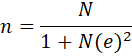
Where:
= sample size
= total population
= level of significance (margin of error)
Usually:
- 0.05 = 5% error margin
Example Calculation
Suppose:
- Population = 500 students
- Error margin = 0.05
Substitute into the formula:
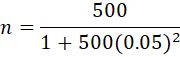
First solve:


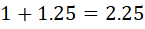


Approximate to:

So, the sample size is 222 respondents.
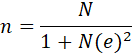
Quick Visual Formula
2. Cochran Formula (Large Population)
Used when the population is very large or unknown.
Formula

Where:
= confidence level (usually 1.96 for 95%)
= estimated proportion
= margin of error
Example
If:
Then:
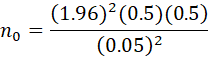

So, the minimum sample size is approximately 384 respondents.
Cochran Formula Block

3. Slovin Formula
Another simple formula similar to Yamane.
Formula
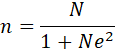
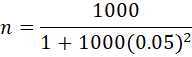
Example:
- Population = 1000
- Error margin = 0.05

4. Krejcie and Morgan Table
Researchers can also use a standard table instead of calculating manually.
Examples from the table
| Population | Sample Size |
| 100 | 80 |
| 500 | 217 |
| 1000 | 278 |
| 5000 | 357 |
| 10000 | 370 |
This method is popular in education and management research.
How to Choose the Right Formula
| Situation | Recommended Formula |
| Undergraduate project | Taro Yamane |
| Large population | Cochran |
| Unknown population | Cochran |
| Simple survey | Slovin |
| Educational studies | Krejcie & Morgan |
Important Terms Explained
Population
The total number of people or items being studied.
Example
All students in a university.
Sample
A smaller group selected from the population.
Example
200 students selected from the university.
Margin of Error (e)
The acceptable level of error.
Common values:
- 0.05 = 5%
- 0.01 = 1%
Confidence Level
Shows how confident the researcher is in the results.
Common levels:
- 90%
- 95%
- 99%
Sample Size Tips
- Larger populations usually require larger samples.
- Do not use a sample that is too small.
- Ensure the sample represents the population.
- Add extra respondents to cover non-response.
Example for a Complete Research Write-Up
Population
The population of the study consists of 1,200 students.
Sample Size Determination
The sample size was determined using the Taro Yamane formula:
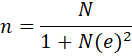
Where:
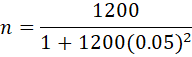


Therefore, the sample size for the study is 300 respondents.
Attention Please!
Advert:
WHATSAPP US ON 08137701720 FOR FREE PROJECT TOPICS,WE GIVE FREE ABSTRACT AND CHAPTER ONE WE ALSO DEVELOP FULL PROJECT